Mary Magdalene, Apostle to the Apostles
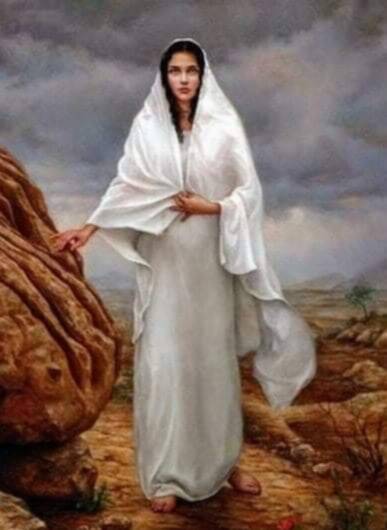
Mary Magdalene was the most influential woman of her time. At at day and age when patriarchy ruled and women were subservient to men, through her relationship to Jesus and her own spiritual understanding and power, as well as her status and social standing, she stands out as an example to all women, both of her time and today.
Mary was born into a wealthy merchant family and was given all the privileges afforded to wealthy women of her day. She was a Myrrophore, also known as Myrrh Bearers, Mistresses of Oils, and Scent Priestesses. Because they eased the dying into the next life and presided over their funerals, they were also called Death Priestesses. These women were initiates in the deep mysteries of life and death, which included the sacred arts of anointing, midwifery, healing, and the resurrection rites. They worked with hands on healing, vocalizations such as chanting and prayer, herbs, and sacred oils for the highest good of All. These traditions extended all the way back through the Isian teachings of Egypt to the ancient mystery traditions of Atlantis. Myrrophores were healers who served in the Temples of Isis, Hathor, and Sekhmet. They worked with dis-ease and disharmony in the spirit and soul as well as the body. These practices were used for millennia to prepare the body and spirit for initiation, birth, death, kingship, queenship, investiture into the priestesshood, and sacred marriage. Their oils carried the codes of transition—guiding souls through the great thresholds of existence. They were capable of guiding souls through profound transformation, healing, and spiritual awakening. The most important work of the Myrrophore was to prepare the dying for their transition. The Myrrhophore would hold a vigil (usually three days) while praying and using chants and sound. The sacred oils, intonations, and rituals would re-align the dying with their true soul essence and carry them to the other side. The combination of the softly spoken chanting, the music, and the aroma of the oils healed the wounds in the soul caused not only by events in this life but also in the past. The Myrrophores served as the bridge between life and death.
Mary advanced through these initiations to become a priestess, earning her the title of Magdalene. She was considered to be the Living Embodiment of the Divine Feminine. She was called "the Initiated and the Initiatrix." She initiated others into the Mystery Traditions that she had been initiated into.
There are no records of where Mary was born and raised, but my guess is that it was in Alexandria, Egypt, a cosmopolitan city of eclectic beliefs and much learnedness. There was a huge library that held the knowledge gathered from the four corners of the known world, many mystery schools of various traditions, a Temple of Isis, a Buddhist community, and an active Jewish community of Therapeuts (which are closely aligned with Esssenes), as well as a Jewish Temple on the Isle of Elephantine, not far from Alexandria.
Since there are no records regarding Mary Magdalene before she appears in Galilee, we do not know when she and her family may have come from Alexandria to Jerusalem, but wealthy families often owned more than one estate. Her connection to Jesus indicates that she and her family probably came to Jerusalem at the same time that John the Baptist and Jesus did. Mary, her sister, Martha, and her brother, Lazarus lived in the town of Bethany, which was within walking distance from Jerusalem, and Jesus often visited there. They were wealthy and Mary often shared of her wealth with Jesus and his followers. Mary and Jesus were a working pair, possibly married, but with definite intimate connections. She was called his companion (“koinonos” in Greek), which puts her on even footing with Jesus.
The Gospel of Philip records that Jesus loved Mary more than all the disciples and often kissed her on the mouth, a fact that made Peter terribly jealous of her. Mary was the one who truly understood the mysteries better than anyone else and Jesus shared teachings with her that he did not share with others, even his male disciples. She was fully enlightened and was the bridge between Jesus and his followers, effectively interpreting his words for them in a way that they could better understand his teachings. She was known as “The Woman Who Knew The All.” She was the leader of the female disciples. The scriptures often mention the women who followed Jesus, and Mary Magdalene is usually mentioned first, but they totally obscure the fact that there was an organized discipleship of twelve women associated with Mary Magdalene. These were Mary, the Mother of Jesus, Mary Jacobi (the Mother of Jesus' sister), the Mother of the disciples James and Joseph, Mary Salome (the Mother of Zebedee's children), Joanna the wife of Chuza, and Susanna. Luke indicates that there were other women there also, but does not name them. My Ancient Disincarnate Mentors have told me that the names of these “other women” were Elizabeth (John the Baptist's Mother), Veronica of the Veil, Claudia (wife of Pontius Pilate), Rebecca (the Sumerian woman at the well), Mary of Bethany, and Martha, her sister. Just as Mary Magdalene has been marginalized, slandered, and erased from scripture, these other women, too, were marginalized by not mentioning them by name and were also slandered by being accused of having demons driven out of them. The scriptures infer that the only thing these women did was provide financial support for Jesus and his disciples.
Luke 8:2-3
Matthew 27:55-57
But Mary was not merely a follower of Jesus, she was his anointer, his initiator, the one who prepared him for his death and transformation. The Gospels describe how Magdalene anointed Jesus with pure spikenard, a highly sacred oil used in ancient rites of initiation, kingship, and preparation for death and resurrection. Mary anointed him as the Christed One, as the Divine Bridegroom, and as one prepared for the great passage beyond death.
The scriptures record this in Matthew 26:
1 And it came to pass, when Jesus had finished all these sayings, he said unto his disciples,
2 Ye know that after two days is the feast of the passover, and the Son of man is betrayed to be crucified. . . .
6 Now when Jesus was in Bethany, in the house of Simon the leper,
7 There came unto him a woman having an alabaster box of very precious ointment, and poured it on his head, as he sat at meat.
8 But when his disciples saw it, they had indignation, saying, To what purpose is this waste?
9 For this ointment might have been sold for much, and given to the poor.
10 When Jesus understood it, he said unto them, Why trouble ye the woman? for she hath wrought a good work upon me.
11 For ye have the poor always with you; but me ye have not always.
12 For in that she hath poured this ointment on my body, she did it for my burial.
13 Verily I say unto you, Wheresoever this gospel shall be preached in the whole world, there shall also this, that this woman hath done, be told for a memorial of her.
This scripture has been deliberately obscured to hide the fact that this anointing took place in the home of Mary, Martha, and Lazarus, and the anointing woman was Mary Magdalene, herself.
“Nicodemus, who had first come to Him by night, also came, bringing a mixture of myrrh and aloes, about a hundred pounds weight. So they took the body of Jesus and bound it in linen wrappings with the spices, as is the burial custom of the Jews.” John 19:39-40
The Jews did not embalm their dead, nor were myrrh and aloes embalming herbs, but powerful healing agents that a healer would use on a severely wounded person.
-------------------
“And when the Sabbath was past, Mary Magdalene, and Mary the mother of James, and Salome, had bought sweet spices, that they might come and anoint him. And very early in the morning the first day of the week, they came to the sepulchre at the rising of the sun” Mark 16:1-2
Mary came to continue the resurrection ritual that she had been conducting on Jesus, along with two other priestesses who were relatives of Jesus.
Don't you think it was unusual that so many women were named Mary? Mary was a title, signifying a priestess. Magdalene was also a title, signifying a High Priestess.
--------------------
As a myrrophore, it was Mary Magdalene, along with the other women, who stood by him as he was crucified. It was Mary who was with him as he hung on the cross. It was Mary who oversaw the anointings and ritual prayers in the sepulchre. It was Mary to whom he first appeared after his crucifixion, and it was Mary whom Jesus instructed to go and testify to his brethren that he had risen. Mary was known as the First Apostle and the Apostle to the Apostles because it was Mary who first testified of his rising.
After Jesus was crucified, he spent some time with his disciples before leaving them, teaching them his final lessons. Gnostic gospels, such as the Gospel of Thomas, the Gospel of Philip, and the Gospel of Mary, give us details of these encounters. These gospels also record Mary's superior spiritual understanding of Jesus' teachings and also of her ministering comfort and instructions to the disciples, as well as Peter's extreme jealousy and hatred of Mary Magdalene, because of her close relationship with Jesus and because she was a woman. Peter considered all women inferior and “not worthy of life.”
Sometime after Jesus' last visit with his followers, Mary Magdalene fled Jerusalem, along with her brother, Lazarus, her sister, Martha, Jesus' two aunts, Mary Jacobi and Mary Salome, Joseph of Arimathea, and a young woman simply called Sarah, and eventually landed by boat on the shores of Southern France, specifically at Saintes Marie de la Mer, a part of the region of Provence.
Provence was a major part of the Roman Empire, a highly developed area with Roman, Greek, and even Jewish communities. It was part of the normal route of trading companies, with a busy harbor. Joseph of Arimethea, a wealthy merchant himself, probably had many business connections there.
From Provence, the company spread out and began preaching. Joseph eventually arrived in Britain and founded Glastonbury. Mary began her work in Marseilles. Lazarus went to Marseilles with her and became the first Bishop of Marseilles before going to Cyprus.
To say that Mary Magdalene spent out her days in France in a cave as a naked penitent does her even more injustice than the falsehoods that were spread about her time in Judea. Mary was a ministering Scent Priestess and Initiatrix with a deep understanding of the thresholds of the spirit world. Her teachings focused on the inner worlds of knowledge and initiation, and emphasized inner preparation, introspection, and inner transformation. She spent her time visiting and teaching among communities which were, at that time, places of Goddess worship, such as pagan temples or groves. She shared her knowledge of the mysteries – how to use the nous, or Eye of the Heart, to see visions of the world of spirit, how to cleanse the mind of its ego in order to purify it and move towards “the Good,” the sacredness of the Union between the masculine and the feminine, how to unify our bodies with our souls to be both fully human and fully divine, how to experience the unconditional love that leads to Oneness with “the Good,” how to achieve gnosis, or a personal relationship with “the Good.” Mary used her words to open hearts and help people to see themselves and their world differently, to free them from the bonds of ignorance. Mary Magdalene almost single-handedly evangelized the entire nation of France.
But Mary Magdalene was not only important in her day; she is important to us, as women, today. On a mythic scale, she is all women. By finding and restoring Mary Magdalene to her rightful status, we restore ourselves to our rightful status. By finding Mary's voice, we find our own. This enables us to find and hear the voice of our own soul. Although she has been made to be invisible by the deliberate efforts of the patriarchy and those with an agenda to silence her, by studying what we do know of her we are enabled to acquire the vision to see what has always been here within our reach. As knowledge of her is restored and as her energy rises in the collective human consciousness, women are also restored to their power and influence and are able to find their spiritual path back to gnosis. The patriarchy that has been in power for so long silenced women and told them they could not speak in church, could not hold public office or positions of power, that they were to obey their husbands, they could not own property, and were treated as little more than chattel. But the Divine Feminine will not be silenced so easily and Her influence has been at work in recent times, empowering women and raising feminine consciousness until Mary Magdalene has exploded into human consciousness. Talk of her is everywhere. Women's groups are being formed to discuss her life and her teachings and even the Catholic church had to admit that they fabricated the accusation of her being a prostitute and gave her her own feast day. As Mary Magdalene regains her power and authority, women gain our power and authority, as well. The Divine Feminine Energy is rising, bringing back harmony and healing to a world long out of balance. We, the women of this world, step forward in our power to reclaim our rightful place and reach out to each other, uniting in spirit, to heal each other and bring wholeness to the collective human consciousness.
November 8, 2025
This article contains my beliefs and understandings. You are free to disagree.